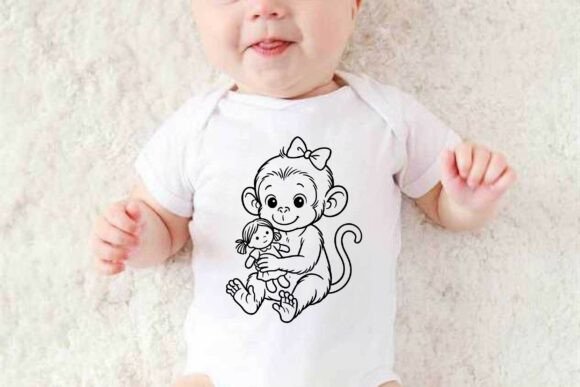
Little Monkey Playing Clipart Vector
When I sit down to review a new asset for my embroidery library, I am rarely looking for something that simply "looks cute." As a designer who stitches for clients and sells finished goods, I need to know if a design will hold up under the needle. It needs to translate from a flat screen into a tactile, dimensional object without losing its soul. This is where most digital assets fail. They look great in a JPEG but turn into a muddy mess of tangled threads on fabric. Recently, I pulled Little Monkey Playing Clipart Vector off the shelf to see how it would fare in a real-world scenario. I wanted to move past the generic description—this is a digital product, ready to print, delivered in a ZIP folder—and get my hands dirty with the actual application.
The First Impression: Mood and Visual Personality
The moment you open the file, the first thing that strikes you is the playful energy. The title says it all: this is not a serious, regal portrait. It is a little monkey playing, which suggests movement, joy, and approachability. For an illustrations category asset, the visual personality is distinct. It does not try to be overly complex or photorealistic. Instead, it relies on clean lines and expressive shapes. This is crucial for embroidery because simplicity often translates better than clutter.
In my experience, designs that rely too heavily on tiny, intricate details often suffer during the digitizing process. Small details can get lost in the stitch density or become hard to distinguish once the thread covers the base fabric. Little Monkey Playing Clipart Vector avoids this trap by focusing on the overall silhouette and the character’s expression. It feels like a design meant to bring a smile, whether it ends up on a nursery wall or a child’s lunch bag. The mood is light, whimsical, and undeniably friendly. It creates an immediate emotional connection, which is exactly what you want when you are trying to sell a handmade product or create a memorable personalized gift.
Real-World Application: From Screen to Stitch
I decided to test this design in a practical context. I had a client request a custom embroidered tote bag for a baby shower. The theme was "wildly adorable," and I immediately thought of Little Monkey Playing Clipart Vector. Why? Because monkeys evoke a sense of fun and curiosity, perfect for a baby-themed event. However, putting a vector clipart into an embroidery project requires more than just hitting the start button on your machine. You have to think about how the design interacts with the fabric.
For a tote bag design, the placement is key. I centered the monkey on the front panel of a natural canvas bag. The contrast between the sturdy canvas and the soft, playful imagery worked beautifully. But here is the reality check: vectors are not automatically machine embroidery design files. Even if you are using software that converts vectors to stitches, you must evaluate the resulting stitch paths. Does the design use a mix of satin stitch for outlines and fill stitch for the body? Or does it rely too much on running stitch for detail, which can look sparse on thick fabric?
In this case, the design’s clean lines allowed for a crisp satin stitch outline that defined the shape clearly against the canvas. The interior could be filled with a simple fill stitch pattern that adds texture without overwhelming the viewer. The result was a high-quality finished product that looked professional. Customers at a craft fair or browsing an Etsy listing can instantly tell the difference between a cheap print and a well-executed embroidery. This design helped bridge that gap, offering the visual appeal of a high-end boutique item while remaining accessible for a small shop owner.
Where Caution Is Required
No design is perfect for every situation, and Little Monkey Playing Clipart Vector is no exception. While it shines on structured items like totes and aprons, there are places where it might struggle. I would advise extreme caution when considering this for small hoop sizes. If you attempt to stitch this onto a tiny patch or a delicate baby bib without adjusting the scale, the details may become indistinguishable. Embroidery has physical limitations; thread takes up space, and too much stitch density in a small area can cause puckering or make the fabric stiff.
Furthermore, consider the fabric type. This design works best on stable, woven fabrics. If you plan to use it on stretchy fabric like jersey knits for a t-shirt, you will need a strong stabilizer to prevent distortion. On textured fabrics, such as heavy tweed or bouclé, the fine lines of the vector might get lost in the weave. Similarly, on dark fabric, you will need to ensure your thread colors provide enough contrast. A light-colored monkey on a black background might require a backing layer or specific thread choices to pop visually.
I also found that curved surfaces, like caps or hats, present a challenge. While possible, the curvature can distort the proportions of the monkey’s face if the design is not digitized with proper curve compensation. For beginners, sticking to flat surfaces like pillow covers, kitchen towels, or aprons is a safer bet. These items offer a large, stable canvas that showcases the design’s strengths without introducing unnecessary variables.
Practical Designer Notes for Success
If you are planning to use this asset for your craft business or as a digital embroidery file for sale, follow these practical steps to ensure quality:
- Test on Scrap Fabric: Never assume a design will work perfectly. Stitch a sample on the exact fabric you plan to use. Check for thread color contrast and how the fabric texture interacts with the stitches.
- Review Stitch Density: Look closely at the digitized file. Are there areas where the stitches are too dense? This can lead to needle breakage or bulky seams. Adjusting the density can improve the drape and feel of the custom apparel.
- Hoop Size Confirmation: Ensure the design fits comfortably within your standard hoop sizes. If it is too large, you may need to split the design, which can leave visible seam lines.
- Black and White Mockups: View your design in grayscale. This helps you assess the value contrast and ensures that the design remains legible even if the colors clash slightly in person.
- Licensing Check: Before selling any commercial embroidery items, double-check the license terms. Some graphics allow personal use only, while others permit commercial sales of finished goods. Clarity here protects your reputation and your bottom line.
Final Verdict on Visual Appeal and Value
Ultimately, Little Monkey Playing Clipart Vector succeeds because it understands its audience. It appeals to parents, gift-givers, and anyone who appreciates a touch of whimsy in their daily life. When used correctly, it elevates a simple item into a special keepsake. For an Etsy seller or a maker selling at local markets, this design offers versatility. It works for holiday embroidery projects, wedding gifts for couples with a playful vibe, or as part of a themed collection for a boutique branding effort.
The design’s strength lies in its balance. It is detailed enough to be interesting but simple enough to stitch reliably. It brings a sense of professionalism to your design assets because it looks intentional and polished. When a customer receives a personalized gift featuring this monkey, they are not just buying a stitched image; they are buying the feeling of joy and care that went into creating it. That emotional resonance is what drives repeat business and positive reviews.
For those looking to expand their inventory of embroidery project ideas, this vector is a solid addition. It pairs well with other nature-inspired or animal-themed graphics, allowing you to create cohesive collections. Whether you are designing a set of tea towels for a kitchen brand or a line of baby embroidery kits, Little Monkey Playing Clipart Vector provides a reliable, charming foundation. Just remember to respect the technical limits of embroidery, test thoroughly, and let the quality of your stitching speak for itself. In a market saturated with mass-produced goods, the human touch of well-executed handmade artistry is your greatest advantage.